

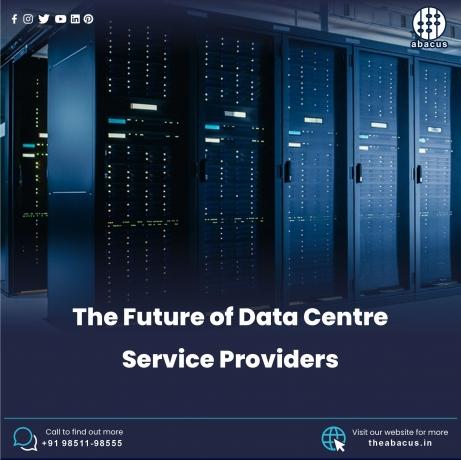
Nowadays, the way of storing and sharing data has been changed because of services of data centre service providers and because of this expansion, many issues have come into existence such as energy conservation, eco-design and the security of the data centre. In data centres, sustainability is becoming crucial day by day, as sustainability not only proves to be beneficial for the environment but also helps in the reduction of operational cost.
The Current State of the Data Centres
The core of the interconnected world are the services of data centre service providers. These are the places or also called facilities which store large amounts of data along with processing it and sharing it. Access to the data is provided with the help of network devices. There is a requirement of high redundancy, scalability and performance for the network specification for data centres. The building blocks of any data centre infrastructure are the network devices-
- The Core Layer: The core layer is the backbone of the networks with high speed switching and routing.
- The Aggregation Layer: It has policy based connectivity. There is inclusion of more capable switches which can perform functions like segmentation, routing between VLANs and QoS policies.
- The Access Layer: It helps in providing connectivity to end-user devices like servers and workstations.
With the advancement in technology, there may be emergence of new networking and data centre architectures in order to address the arising requirements. The innovations can even lead to replacement of existing architectures like leaf and spine in certain contexts. The operations related to data centres are done in the servers, where data is created, edited, shared and archived in these devices like-
- Virtualisation Servers: The main function of virtualisation software is to create and manage virtual machines (VMs). It helps in the optimisation of the resources along with utilisation in the data centres. Ethernet connection is used by most of the servers for the purpose of network connectivity.
- Storage Servers: Network attached storage or storage area network is being provided by storage servers These are committed to store and manage the data and in storage area networks, fibre channel connections are used by servers in order to provide high-speed access to the storage device. Fibre channel switches and HBAs help in establishing the connection.
Data centres are known for providing higher bandwidth and throughput which makes them an ideal solution for data-intensive applications. However, with the advancements in the technology, new data centre architectures are emerging which help address the emerging requirements.
Services of Data Centre:
Data centres provide many services related to IT and infrastructural needs of the organisation. Below given services are being offered by data centres:
- Colocation Services: In colocation services, organisations are allowed to lease physical rack space along with their facility. Customers can provide their own servers and get benefit of the data centre's connectivity along with the physical security.
- Dedicated Servers: These servers are being fully managed by the data centre service providers. In this, works like hardware maintenance, software updates, security and round the clock monitoring are done.
- Cloud Services: The cloud services include Infrastructure as a service and platform as a service, allowing users to leverage scalable resources, storage and applications on-demand.
- Backup and DR Solutions: These allow businesses to protect their data from file servers, databases and other applications. In these services, automated backups and data replication are included which help to minimise downtime in cases of disasters.
- CDN Services: Delivery of web content, applications and media is improved by distributing them over multiple data centre locations, thereby enabling customers to reduce latency issues.
Data centre service providers have started to extend their services in order to support the edge locations with the rise of edge computing. These data centre services have also started to offer businesses the ability to process data closer to the source, hence leading to reduction in the latency for applications like IoT and real time analytics.
Overall, seeing the increasing demand of data centre services, the future of data centre service providers seems to be bright. The Abacus is committed to lead the evolution by introducing new technologies, giving priority to sustainability, and delivering secure and flexible solutions.